Showing posts with label ideology. Show all posts

Wednesday, 10 August 2016

Heroic Hogwash


German planes bombed Reg’s ship and he made a lucky escape from the wrecked boat. When he arrived in Crete, he had only the clothes he wore and nothing else. After thousands of enemy paratroopers parachuted into Crete, Reg’s battalion was meant to replace 20th Battalion, which had counterattacked Maleme airfield, but arrived too late to succeed. They withdrew to the new frontline at Souda Bay, nicknamed 42nd Street. When a raiding party of 400 Germans stumbled into sight, the Anzacs called out a battle cry, firing as they ran, thrusting their bayonets at the enemy. The German fighters fled for their lives.

“They were highly trained Germans, but they got such a shock at our din and the way we ran that they forgot they were supermen, and ran … the whole 400 of them.”

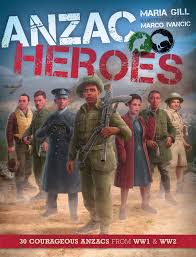
This is a quote from page 68 of Maria Gill’s “Anzac Heroes”, and it gives you an idea how exciting this book is to read. ‘Reg’ is Reginald Saunders and there is a really realistic picture of him in uniform holding a massive machine gun over his shoulder, the same image is on the cover. We can scan the page and very easily tell exactly what medals he was awarded for his bravery. The coloured medal icons are listed in the helpful “medals” section at the back of the book. We can also tell very easily which of the five aspects of History Reginald took part in: the little tank icon means ‘Army’. (The other four aspects are Air Force, Intelligence, Medic and Navy). A helpful kangaroo icon tells us that he is Australian. Sometimes when reading ‘Anzac Heroes’ it’s a bit confusing which hero belongs to which war, WW1 or WW2. After all, the Germans were the Baddies in both wars. I figured out though that Reginald belongs to WW2, as page 68 belongs to the second half of the book. There’s a really cool map with lots of arrows on it half way through the book to show that we are moving from WW1 to WW2. There’s a boring timeline too with lots of dates and facts about which battle was which, but I preferred to skip this part and just focus on the really cool war stories.

Some really racist and sexist books about war focus just on heroic white men. Anzac Heroes doesn’t do this, it has several brown heroes (both Aboriginal and Maori) and several women. The women aren’t quite as cool as the men because they only get to be nurses or spies. The Aboriginal and Maori soldiers are really cool though, they were really brave and sometimes scared the Germans by doing Hakas and war dances. Actually, even though there were lots of racist people back in the old days, war was really good for Maori and Aboriginal soldiers. Soldiers like Reginald Saunders got lots of awards and like it says on page 69 the RSL even set up a scholarship in his name for Aboriginal people. Another example is the Maori soldier Lt Col Sir Peter Buck who proved how awesome he was in Gallipoli and then got to be second in command of the Maori Battallion and then became a famous anthropologist.

The best things I liked about ‘Anzac Heroes’ were the pictures and the really realistic war stories and how heroic the soldiers were. You get to learn all about different types of medals and lots of different battles. There are also some very helpful and in-depth sections at the back which talk about things like The Military, The Medics and a Glossary. So you can look up funny words like ‘gangrenous’, ‘panzer’ and ‘flak’. There’s even a section which explains in depth why the Anzac heroes had to fight against the Germans:

At the beginning of the 20th Century, New Zealand and Australia were part of the British Empire as self-governing Dominions. When Britain went to war, they committed themselves to defending Empire. Politicians worried that the war would spread to their shores and wanted to support the Empire’s effort to prevent that from happening.

So I think that the moral or the message of the book is that Anzac Heroes needed to fight the Germans so that they didn’t land in Australia or New Zealand and take over our countries. If it wasn’t for the brave and daring fights that they got into, we’d all probably be speaking German now and doing Nazi salutes.

But really the best thing about Anzac Heroes that stood out for me and would make me recommend it to my friends and family was the fact that it wasn’t even about politics or history it was about character and bravery. Like it says in the introduction:

“While reading about each hero you will discover what built their character, what helped and hindered them during the war, and what happened to them afterwards – if they made it home.”

So in conclusion I think Anzac Heroes is a really good book which belongs on the bookshelf of every New Zealand and Australian home. It’s got lots and lots of important facts about heaps of battles from WW1 and WW2 and also some really realistic pictures. It has a personal touch which means it isn’t boring to read and also it is very moving and emotional because of the sacrifices made by the Anzac soldiers. Lest We Forget.


Saturday, 8 August 2015

Anzac Day and the Politics of Forgetting


This is the full text of a speech I gave recently for the International Socialist Organisation in Wellington and Dunedin. For a shorter version of the speech, go to the ISO website: http://iso.org.nz/2015/07/22/the-anzac-spectacle-gallipoli-peter-jackson-and-the-politics-of-forgetting/


This year New Zealand and Australia commemorated the 100th anniversary of the Gallipoli campaign. One hundred years ago thousands of Allied troops invaded what was then the Ottoman Empire on April 25th 1915. The ensuing eight month battle was a grim and bloody affair fought within a tiny section of the Mediterranean coastline. Casualties were heavy on both sides, with the number of Turkish / Arab deaths being by far the highest. It was the first major battle the newly christened 'Anzac' soldiers had been involved in, and the large number of deaths had a profound impact upon the people of New Zealand and Australia. The following years of battle took an even heavier toll, but this first shock assumed a sort of mythic status, and now the date of April 25th is the focus of WW1 commemoration in New Zealand and Australia.


Monday, 6 April 2015

Some thoughts on the 'Camp Gallipoli' saga


I knew nothing about the 'Camp Gallipoli' concept until today when I heard about it on the radio. For the price of a mere $100, New Zealanders would be entitled to the privilege of camping out under the stars in Ellerslie Racecourse, honouring the memory of the brave Anzacs by sleeping outside and being woken at dawn for a special memorial service. Local band Evermore would provide the theme tune to the event, and high profile New Zealanders such as Sir Richard Hadlee, Sir Graham Henry, Annabel Langbein and Nigel Latta were backing the event alongside the RSA.


Unfortunately for the organisers only 102 people bought tickets, and they have had to cancel the event because it is not viable. It was planned to attract between 10,000 and 20,000 people.


Saturday, 7 March 2015

A few thoughts on Stevan Eldred-Grigg's 'The Great Wrong War'


I read this book very recently, and have been meaning to write a 'proper' review on it for some time. Unfortunately I have too many other projects on the go, so I it might never happen. So instead of a 'proper review' just a few thoughts.


Friday, 27 February 2015

Anzac rhetoric and the Iraq war

I recently posted a comment on facebook expressing my outrage and disgust at Hekia Parata's comments in support of the move to send NZ troops to Iraq. Like many other people in New Zealand I'm angry at the Key government for maneuvering us into this misguided war. My emotional response was further inflamed by these words quoted in a recent (26/02) Herald article :


Education Minister Hekia Parata said in a fiery speech she was raised on the history of war heroes and turning out for Anzac Day and the point of having a defence force was to carry out such deployments. She said the country could not evoke the emotion of turning up to Anzac Days but then turn away when the practical reality of what that meant presented itself.


The article continues with sickening details from Parata's speech. She links Anzac “values” with the content of the New Zealand school curriculum, and argues that we should send troops to be true to that legacy of courage, responsibility and wisdom.


Monday, 2 February 2015

The Curator's Reply


The short history of this blog has so far been a fairly lonely one. I have received a few positive comments from like minded friends and people who share my perspective on New Zealand's role in WW1. While these are appreciated, I had hoped to receive some critical comments too. Many of the opinions expressed in this blog are clearly opposed to the more mainstream views of Anzac day seen in Newspapers, TV and various magazines. I provided a link to my blog at the official government “WW100” site, and various other internet sites which related to this topic. The results were a handful of views, but no comments on any of my posts.


Wednesday, 3 December 2014

Some thoughts about courage (part one)

I've been working on this for a while and it's still not really finished - I need to tie it back to Baxter again, so I will write a part two later.

The motivation for this post is a recent article in the ODT about Archibald Baxter and the conscientious objectors. There's an interesting quote in the article by Professor Tom Brooking, who describes both the pacifists such as Baxter and the regular soldiers as brave:


Sunday, 23 November 2014

Robin Hyde's 'Nor the Years Condemn' and the ideology of Anzac Day

The following is the text of a speech I gave recently at the 'War Memorialisation and the Nation' conference at the University of Otago. It turned out to be far too long for the 30 minute time limit, and although I'm reasonably happy with it as it stands, there's a lot more work to be done. The concept of Anzac ideology is just a sketch, which requires a lot more further development. 


Friday, 13 June 2014

WW1 vs. WW2 in 1957


I've been thinking quite a lot about the claim I made in an earlier post that world war one is 'overshadowed' by world war two. Since writing that post, I've watched two films which I think illustrate that claim in an interesting way: The Bridge on the River Kwai, David Lean's famous movie about WW2 prisoners forced to build a bridge for the Japanese, and Paths of Glory, Stanley Kubrick's not so famous movie about French soldiers in WW1.

Thursday, 12 June 2014

Schools, children, history and values

Not long ago I was walking behind a group of Y13 students on my way to the staff room at the school where I work as a relief teacher. Two of them were prefects, the other was a German exchange student. It was a few weeks before Anzac day, and the German student asked the other two what it was all about. They didn't have a very in depth conversation about it, but the few sentences I overheard “Oh it's about the war … history and stuff …. they get you to read these bits from the bible and do this ceremony” were followed quickly by laughter and a change of topic. There was absolutely no hint of discomfort or anything due to the fact that the student was German. Rather, this was Boring Adult Business: they make you bow your head, read from the bible, sing the national anthem: all that sort of stuff. You, as a teenager, hold your breath and go through all the motions, waiting for the bell to ring.


Saturday, 7 June 2014

Three articles on D Day

Yesterday was the 70th anniversary of D Day, often presented as the final crucial battle of world war two. Here are three perspectives on the significance of this day:

Alan Woods, writing for 'In Defence of Marxism' (21/07/2004)

 
Last month's celebrations around the 60th anniversary of D-day were designed to perpetuate a myth. The Normandy landings did not end the Second World War in Europe, which was fought and won on the eastern front.


To say this is not to belittle the courage of the British and American troops. The soldiers who had to endure the Normandy landings went through hell. According to figures issued by Supreme Headquarters, Allied casualties in the first 15 days of battle totalled 40,549. The British lost 1,842 killed, 8,599 wounded, and 3,131 missing. The Americans lost 3,082 killed, 13,121 wounded, and 7,959 missing. The Canadians lost 363 killed, 1,359 wounded and 1,093 missing. This was bad enough Yet it does not bear comparison with the appalling losses suffered on the eastern front. (See Martin Gilbert, Second World War, p. 536.)


All the peoples paid a terrible price for the War. Britain's casualties totalled 370,000, the USA, 300,000. But the Soviet Union lost a staggering 27 millions – about half of all the casualties of the Second World War. According to one estimate, even before the Normandy landings, 90 percent of all young men between the age of 18 and 21 in the Soviet Union had already been killed. These chilling figures accurately express the real situation. They show that the people of the Soviet Union suffered a disproportionate number of casualties, because the main front in Europe was the eastern front.”


Gwynne Dwyer, writing for the Winnepeg Free Press (06/06/2014)

 
It seems churlish to insist the Second World War was just another great-power conflict on the day when the last survivors of the generation who fought in it are gathering, probably for the last time, to honour those who died on the beaches of Normandy. But there is no other time when people will actually pause to listen to such an assertion, and it is important they understand it.


If the world wars were moral crusades against evil, then our only hope of avoiding more such tragedies in the future (probably fought with nuclear weapons) would be to extinguish evil in the world. Whereas if they were actually traditional great-power wars, lightly disguised, then we might hope to stop them just by changing the way the international system works.”


An anonymous editor, writing for the Guardian (05/06/2014)

The British understanding of D-day has probably shifted more than that of any other nation. At first we thought we British had won the war, with some late-arriving help. Then we conceded, bearing in mind the Pacific, that the Americans had won it. Only later was it grasped that Russia had borne the greatest strain.


Even now, an obsolete view of Britain's role underpins isolationist thinking in this country. What is not disputed is that the way the western allies fought increased the pressures for more democratic and egalitarian societies. The distance between officers and men shrank, engagement and understanding was as important as obedience, men and women worked with equal energy for victory and, as bombs tore at the cities, shared risks.


All this prefigured a different attitude to class and gender after the fighting stopped. The level of solidarity achieved during the conflict, even if somewhat romanticised, has become a standard by which to measure how far we have fallen since.”

Link to full article 

Whereas the first two articles take a critical historical perspective, the Guardian article swiftly and deftly brackets off any concern with actual history ('Only later was it grasped that Russia had borne the greatest strain'), and then proceeds to establish D Day as a repository of timeless values ('a standard by which to measure how far we have fallen since'). Reading the comments BTL on this article and others, the emphasis is often put on the generation itself: the Greatest generation (heroic 1940s people fighting fascism), and the Greatest victory (defeat of Hitler). This is put in stark contrast with our contemporary 'fallen' generation, who have no idea of the sacrifices, the solidarity, the values of the Great 1940s Heroes.


Although I endorse the critical historical engagement of the first two articles, and find the ideological undercurrents of the Guardian article deeply disturbing, I'm not sure that this sort of commemorative ideology is actually challenged by an honest, sober, critical historical perspective. Just like with our own ANZAC Day, history itself is very quickly disposed of: what we are morally compelled to "Remember" is not an historical event at all but a set of moral values. It is very easy for the writers of these quasi religious tracts to accept the charges - eg, 'Yes, OK, it was the Russians who really won the war' - even to the extent that war itself is held up to be a tragic and horrible waste. 


On the other hand, it appears very difficult for people who are suspicious of these hagiographical efforts to denounce them for what they are, without appearing monstrous or insensitive. Of course, Hitler was a very evil man, and fascism had to be defeated. Of course, the men who fought in battles such as D Day displayed bravery. 


What bugs me the most are two things: first, the idea that battles themselves are the most important and significant things we should remember. It's the context of those battles, and the sort of sober, critical historical understanding I mentioned above, which needs to be promoted. I don't completely object to the sentimental commemoration of dead soldiers, it's the fact that this is what dominates our collective "memory" which disturbs me.


Secondly, the idea that we must look to the past for moral role models, and that we can find them in dead soldiers. The subtext - sometimes very explicitly stated - is that we are unaware of the "price of freedom" which has been payed by soldiers such as those who fought in the Normandy landings in 1944. We are morally compelled to remember their sacrifice, which involves assuming a grateful, humble, reverent attitude towards our Heroic forebears. There's a reactionary conservatism here which is dressed up in the clothes of sentiment. We are the ungrateful, spoiled children of the 21st century. We must recognise our privilege, and bow our heads before our morally superior ancestors.


Edit (14/06/2014)
This post was written in a bit of a hurry, and it would have been better if I had included  this discussion between two socialists about the nature of D Day. 

I am relatively ignorant about the historical and military intricacies involved in this sort of discussion. This is partly why I focus on the ideological side of the issue. 

I didn't mean to imply that critical historical engagement - whether Marxist, like Gwynne Dwyer, or otherwise - was pointless or irrelevant. I think the exact opposite; it should be relevant and we should do as much as possible to promote a thinking attitude, rather than a reverential attitude, towards history.


Tuesday, 20 May 2014

Forensic History

There's a recent Sunday TV documentary called Sharidyn's Homecoming, which tells the story of the NZ family of 14-year-old Kiwi-born schoolgirl Sharidyn Svebakk-Bohn. Along with 76 other people, mostly young teenagers, Sharidan was murdered by the far right terrorist Anders Breivik in 2011. I don't usually watch these sorts of documentaries, as they tend to indulge in a form of sentimentalism I do not like. This documentary however was quite well done, and the interviews with Sharidyn's mother made fascinating viewing. Inevitably there were scenes showing photos of Sharidyn with emotive piano music in the background, but this sort of thing was done in a sensitive and relatively restrained fashion, considering the enormity of the horror her family must have endured.


Friday, 16 May 2014

Missions and Objectives

I have just been reading through the “Missions and Objectives” of the official government project for WW1 centenary commemorations. You can see for yourself at this website


I was compelled to make some comments of my own.

Wednesday, 14 May 2014

Inglorious Basterds, a Donkey Bridge and an Ex Nazi

The First World War is fairly consistently overshadowed by its more spectacular and far more deadly sequel, World War Two. Although many historians and intellectuals might regard both wars as being equally momentous and consequential, I think that from the perspective of popular culture in the 21st century, WW2 wins against WW1 in terms of fame and impact by a large margin. I'm not sure what the exact statistics are, but I am quite certain that the number of Hollywood movies made about WW2 far exceeds the number made about WW1. There are some very interesting and notable movies made about WW1, such as All Quiet on the Western Front. Whatever artistic merits these films might possess, they lack a crucial ingredient: the Nazis.


Friday, 25 April 2014

Those hideous, bloated corpses: the ideological structure of Anzac day

Imagine a parallel universe in which New Zealanders were violent, warlike and proud of their record of victory over the course of the twentieth century. Instead of focussing on the virtues of the dead New Zealanders, Anzac day in this alternate nasty New Zealand would focus on the evil of the enemies we fought. At the head of the ceremony would be a proud warrior bearing a pole, skewering the shrunken head of German soldier from Kaiser Germany. Next in line would be a preserved Nazi, which would be ceremonially spat upon and cursed by the vicious crowd. Following in the wake of these would be a curious assortment of shrunken heads: Samoan1, Korean, Malaysian2, Vietnamese, Afghani. Now imagine a curious child who asked his parents “Who are the bad guys now?”. Somewhat uncomfortably, a little unsure of themselves the parents reply “The Russians”. Then the child asks “Why do the bad guys keep changing countries?”.


Wednesday, 23 April 2014

Another puff of air

It's somewhat disappointing that the Guardian published this article
  
But I managed to get in the first BTL comment .... nice to see some conscious Aussies there saying sensible things too.

Tuesday, 22 April 2014

Field Punishment No. 1

Here's a link to a preview of the movie in case you missed it. 


I should be grateful, I suppose, that a movie based on Archibald Baxter's memoir We Will Not Cease has been made at all. I should be even more proud of TV One for showing the movie last night in prime time. Baxter and the other conscientious objectors are portrayed as proud – and more importantly bravemen of high moral principle. The officers were nasty. The trenches were awful. The nurse at the hospital was pretty. It was a sad and terrible war and this was duly emphasised by the incessant and emotive piano soundtrack.


Monday, 21 April 2014

ANZAC Day and the Politics of Sacrifice


Bold and bloody, set upon the mountain tops of human experience, we dimly perceive through the foggy lens of history moments of supreme and selfless giving. In the biblical tradition the notion of sacrifice is both supremely powerful and supremely awful. Abraham submits to the will of God and comes very close to killing his own son. He was only testing him apparently, but such a test can be viewed as either spiritual triumph or twisted and malicious abuse of power. Jesus dies upon the cross and is resurrected on the third day. Once again God seems to be giving us a mixed message: we are redeemed, but we are also reminded of our fundamentally sinful nature.