Showing posts with label Anzac day. Show all posts

Wednesday, 10 August 2016

Heroic Hogwash


German planes bombed Reg’s ship and he made a lucky escape from the wrecked boat. When he arrived in Crete, he had only the clothes he wore and nothing else. After thousands of enemy paratroopers parachuted into Crete, Reg’s battalion was meant to replace 20th Battalion, which had counterattacked Maleme airfield, but arrived too late to succeed. They withdrew to the new frontline at Souda Bay, nicknamed 42nd Street. When a raiding party of 400 Germans stumbled into sight, the Anzacs called out a battle cry, firing as they ran, thrusting their bayonets at the enemy. The German fighters fled for their lives.

“They were highly trained Germans, but they got such a shock at our din and the way we ran that they forgot they were supermen, and ran … the whole 400 of them.”

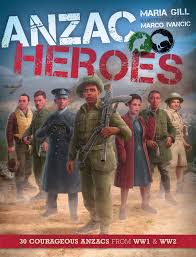
This is a quote from page 68 of Maria Gill’s “Anzac Heroes”, and it gives you an idea how exciting this book is to read. ‘Reg’ is Reginald Saunders and there is a really realistic picture of him in uniform holding a massive machine gun over his shoulder, the same image is on the cover. We can scan the page and very easily tell exactly what medals he was awarded for his bravery. The coloured medal icons are listed in the helpful “medals” section at the back of the book. We can also tell very easily which of the five aspects of History Reginald took part in: the little tank icon means ‘Army’. (The other four aspects are Air Force, Intelligence, Medic and Navy). A helpful kangaroo icon tells us that he is Australian. Sometimes when reading ‘Anzac Heroes’ it’s a bit confusing which hero belongs to which war, WW1 or WW2. After all, the Germans were the Baddies in both wars. I figured out though that Reginald belongs to WW2, as page 68 belongs to the second half of the book. There’s a really cool map with lots of arrows on it half way through the book to show that we are moving from WW1 to WW2. There’s a boring timeline too with lots of dates and facts about which battle was which, but I preferred to skip this part and just focus on the really cool war stories.

Some really racist and sexist books about war focus just on heroic white men. Anzac Heroes doesn’t do this, it has several brown heroes (both Aboriginal and Maori) and several women. The women aren’t quite as cool as the men because they only get to be nurses or spies. The Aboriginal and Maori soldiers are really cool though, they were really brave and sometimes scared the Germans by doing Hakas and war dances. Actually, even though there were lots of racist people back in the old days, war was really good for Maori and Aboriginal soldiers. Soldiers like Reginald Saunders got lots of awards and like it says on page 69 the RSL even set up a scholarship in his name for Aboriginal people. Another example is the Maori soldier Lt Col Sir Peter Buck who proved how awesome he was in Gallipoli and then got to be second in command of the Maori Battallion and then became a famous anthropologist.

The best things I liked about ‘Anzac Heroes’ were the pictures and the really realistic war stories and how heroic the soldiers were. You get to learn all about different types of medals and lots of different battles. There are also some very helpful and in-depth sections at the back which talk about things like The Military, The Medics and a Glossary. So you can look up funny words like ‘gangrenous’, ‘panzer’ and ‘flak’. There’s even a section which explains in depth why the Anzac heroes had to fight against the Germans:

At the beginning of the 20th Century, New Zealand and Australia were part of the British Empire as self-governing Dominions. When Britain went to war, they committed themselves to defending Empire. Politicians worried that the war would spread to their shores and wanted to support the Empire’s effort to prevent that from happening.

So I think that the moral or the message of the book is that Anzac Heroes needed to fight the Germans so that they didn’t land in Australia or New Zealand and take over our countries. If it wasn’t for the brave and daring fights that they got into, we’d all probably be speaking German now and doing Nazi salutes.

But really the best thing about Anzac Heroes that stood out for me and would make me recommend it to my friends and family was the fact that it wasn’t even about politics or history it was about character and bravery. Like it says in the introduction:

“While reading about each hero you will discover what built their character, what helped and hindered them during the war, and what happened to them afterwards – if they made it home.”

So in conclusion I think Anzac Heroes is a really good book which belongs on the bookshelf of every New Zealand and Australian home. It’s got lots and lots of important facts about heaps of battles from WW1 and WW2 and also some really realistic pictures. It has a personal touch which means it isn’t boring to read and also it is very moving and emotional because of the sacrifices made by the Anzac soldiers. Lest We Forget.


Tuesday, 26 April 2016

Best of Anzac day 2016

I have been meaning to write here for some time, but for various reasons it just hasn't happened. Top of my list is to write about the year 1916 - the year of the first Anzac day commemoration, and also the year conscription was introduced. It's a dark and shameful year in New Zealand's history, in which the rhetoric of sacrifice is the driving force behind the move to introduce compulsory military service. Was the first Anzac day commemoration a significant part of this lead up to the introduction of conscription? How did people opposed to New Zealand's involvement in the imperialist slaughter deal with the emotionally charged atmosphere of the time? Hopefully I will have the time soon to do justice to these questions.

In lieu of anything original, here are my Anzac picks of 2016:

The best and most prominent act of counter propaganda was without doubt the fantastic Archibald Baxter - field punishment - "guerilla installations" dotted around Wellington. What makes this even better is the Stuff article and the accompanying video, unusually positive for this time of year: http://www.stuff.co.nz/national/last-post-first-light/79299545/conscientious-objector-archie-baxter-remembered-in-guerilla-wellington-sculpture

Peace Action Wellington may or not be responsible for this, but they have some really good pictures of the Archie mannequins: https://peaceactionwellington.wordpress.com/

Renee Gerlich takes on the grotesque spectacle of Peter Jackson's 'Scale of our War' exhibition at Te Papa, and does a fine job of cutting it down to size. I was somewhat depressed when I visited Wellington recently and saw for myself the massive ques of people lining up to see this exhibition. If only they could all be directed to this:

Not only does Te Papa seek to re-sell the “grand adventure” story all over again, but to bond us to it, have us identify with it. Through the uniforms you can don, the questions you are invited to answer, the poppies you can leave heartfelt messages on – but also through its insistence on speaking in the first person plural. It’s the scale of “our” war. “We” were in Egypt when they told “us” that “we’d” be invading Gallipoli. “The Turks had sided with the Germans in the war, and we were itching to take them on… that’s where the action was.” That text is not even quoted from a letter or a journal. That’s just Te Papa speaking – as your quintessentially Kiwi, male war hero “mate”.

Read the full blog here: https://reneejg.net/2016/04/22/gallipoli-the-scale-of-our-war-propaganda/

Over the ditch where the Anzackery is even more hyped and pumped by gazillions of state dollars, not everyone is buying the same old story. Historian and aboriginal activist Gary Foley contrasts the attention paid to Anzac day with the denial of Australia's own colonial history: http://www.theage.com.au/comment/gallipoli-not-the-only-war-to-define-australian-warfare-20140424-zqymi.html

I posted last year about Scott McIntyre, the sports reporter who was fired from his job after a series of 'offensive' tweets about Anzac day. McIntyre referred to several historical episodes which are typically ignored by Anzac commentators: the so called 'battle of the Wazza', the Surafend massacre, the raping of Japanese women by Anzac soldiers and our complicity with the mass murder of Hiroshima and Nagasaki in 1945. It is not hard to imagine the immense pressure someone in McIntyre's position must have come under after this episode, so I am very impressed to see that he has not succumbed and continues to offend people blinded by Anzac nonsense: http://www.theguardian.com/news/2016/apr/25/former-sbs-reporter-scott-mcintyre-repeats-anzac-day-accusations-on-twitter

Finally, this youtube video of a debate between Australian academics is really worth a look. I think it might be from a year or two ago, but I only discovered it today thanks to the sharing miracles of facebook. The moot is the proposition "Anzac day is more puff than substance", and the first speaker (Jeff Sparrow) absolutely nails it. He starts about seven minutes into the clip, and doesn't talk too long: https://www.youtube.com/watch?v=pk5MgWXDM2A&feature=youtu.be&t=7m16s


Saturday, 8 August 2015

Anzac Day and the Politics of Forgetting


This is the full text of a speech I gave recently for the International Socialist Organisation in Wellington and Dunedin. For a shorter version of the speech, go to the ISO website: http://iso.org.nz/2015/07/22/the-anzac-spectacle-gallipoli-peter-jackson-and-the-politics-of-forgetting/


This year New Zealand and Australia commemorated the 100th anniversary of the Gallipoli campaign. One hundred years ago thousands of Allied troops invaded what was then the Ottoman Empire on April 25th 1915. The ensuing eight month battle was a grim and bloody affair fought within a tiny section of the Mediterranean coastline. Casualties were heavy on both sides, with the number of Turkish / Arab deaths being by far the highest. It was the first major battle the newly christened 'Anzac' soldiers had been involved in, and the large number of deaths had a profound impact upon the people of New Zealand and Australia. The following years of battle took an even heavier toll, but this first shock assumed a sort of mythic status, and now the date of April 25th is the focus of WW1 commemoration in New Zealand and Australia.


Monday, 20 April 2015

Links Update

I was really pleased to receive an email from Jared Davidson recently, he is the author of 

Fighting War: Anarchists, Wobblies and the New Zealand State 1905 - 1925 

....which I referred to in an earlier post. There's a fascinating history here which tells the stories of socialists, anarchists, anti - miltarists and labour activists who were opposed to the war. They might have been a minority group, but the more I read about them the more significant I think they are. He has written two other valuable articles which cast more light on this history:

Socialist cross of honour: Makings of a working class counter culture 

and

Remains to be seen: Tracing Joe Hill's Ashes in New Zealand 

I'm also going to highlight a specific page on the 'Honest History' website which has a list of links to articles and information about the Armenian Genocide. There is a lot more of interest contained in the Honest History site, it is a really valuable resource.

Honest History list - Armenian Genocide 

Finally (for now) a piece by Dougal McNeill - impressions and reflections on Anzac day inspired by his experience of the opening of the Pukeahu National War Memorial Park in Wellington. I think his comments on Anzac as a kind of hyper-real spectacle are spot on, and I suspect there is more to be said on this topic. 

Anzac: they'll remember it for us wholesale

Friday, 17 April 2015

The Absurdity and Obscenity of Gallipoli


As we appoach the Gallipoli centenary, I have set myself the task of re – reading some of the best examples of New Zealand writing about the disastrous invasion. There are three books, Ormond E Burton's 'The Silent Division', Robin Hyde's 'Passport to Hell' and Alexander Aitken's 'Gallipoli to the Somme', all based upon first hand experiences of New Zealanders who fought in the bloody trenches of Gallipoli. I'll start with the horror and some images of the 'fallen'. Here is Private J. D. Stark (8/2142, Fifth Reinforcements, Otago Infantry Battalion) describing the bodies of the dead:


But the dead who waited in No Man's Land didn't look like dead, as the men who came to them now had thought of death. From a distance of a few yards, the bodies, lying in queer huddled attitudes, appeared to have something monstrously amiss with them. Then the burying-party, white faced, realised that twenty four hours of the Gallipoli sun had caused each boy to swell enormously – until the great threatening carcases were three times the size of a man, and their skins had the bursting blackness of grapes. It was impossible to recognise features or expression in that hideously puffed and contorted blacknessi.


Tuesday, 14 April 2015

A link to my Daily Blog Anzac post

Here's a link to my 'Guest Blog' at the Daily Blog. 

An Anzac Thought Experiment 

 I've submitted an edited version of this to a few mainstream press papers too. I have never done this before, but obviously this is the only time of year I am going to have a chance of getting mainstream exposure. My goal for the next ten days is to write a series of short, punchy pieces which will hopefully travel beyond the already converted readership of this blog. Any words of advice about how I might improve my chances would be appreciated. The Daily Blog is a good start, but I reckon if this blog was doing its job properly I would get heaps of abusive comments on it. So Please help me out and share the word on facebook at least.

Haunted Gold: the dubious profits of Gallipoli

Based on interviews with war veteran Douglas Stark, Robin Hyde's book Passport to Hell is one of the most readable and insightful books about the New Zealand experience of the trenches of World War One I have read. Starkie is a rebellious, tough and frequently violent character who gives a raw and completely unsentimental picture of the reality of trench warfare. As we approach the Gallipoli centenary it is his descriptions of the blackened and bloated corpses lying in No Mans Land which stick in my mind most of all. What also comes to my mind is the focus of Hyde's Gallipoli narrative: money. After the horror and sense of disgust has worn off, Starkie and his mates focus on gambling. Trench warfare involved a huge amount of boring waiting, and Anzac soldiers filled up the hours with coin games of 'Two Up' and card games to distract themselves from both the tediousness and the horror of the war:

Monday, 13 April 2015

What do the Pope, Kim Kardashian and the Anzacs have in common?


The answer is that they all have some major form of influence over the upcoming centenary of the Armenian genocide, which began on April 24th 1915 – just one day prior to the famous Gallipoli landings.


Only 22 countries officially recognise the Armenian genocide, which took the lives of at least 1.5 million people. From what I have read this is actually a conservative estimate, and does not take into account the deaths of other Christian minorities. Recognition – or rather the lack of it – is a major political issue for some of the countries which have important relationships with Turkey. New Zealand, along with the US, Australia and Israel all fail to officially recognise the Armenian genocide. Diplomatically making this sort of recognition is a very big deal, and Turkey takes a very hard line against any country which dares to make this sort of statement. With the centenary approaching, and high profile people like the Pope and Kim Kardashian helping to raise the issue, it isn't too surprising that Turkish PM Recep Erdogan is looking for cover. Where exactly will he hide? Well, the Anzac centenary is pretty damn close, so who will notice if he moves it a day behind to coincide with the Armenian genocide centenary?


Sunday, 12 April 2015

Anzac 'remembrance' and Anzac virtues: different narratives

John A Lee in 1936. He lost his arm in the war.


How exactly are we supposed to honour the solemn Anzac imperative 'Lest We Forget'? After a century, actual living memories of the so called 'Great War' no longer exist. The thousands of dead New Zealanders and Australians who died on the slopes of Gallipoli are represented by lists of names etched onto memorials, black and white photos of young men wearing lemon squeezer hats. Newspapers run hundreds of stories about individual soldiers and how and where they died. Families are shown holding pictures of their relatives from 100 years ago, medals are proudly displayed. Thousands of people will wear red poppies and attend dawn services on April 25th in order to attempt to honour the memory of the dead.


Saturday, 11 April 2015

John Key's Gallipoli Wisdom


I've been working on a sort of 'side project' recently which involves learning more about the Middle East. I'm particularly interested in the historical connections between what we see happening now in places such as Syria and Iraq, and the dissolution and carving up of the Ottoman Empire after WW1. I'm also interested in Turkey, one of the most powerful and relatively stable states to form out of the ruins of the Ottoman Empire. As I wrote a couple of years ago, it was the experience of travelling in Turkey and seeing all of the massive monuments dedicated to Kemal Ataturk which got me thinking about the strange and disturbing reality of the New Zealand Anzac tradition.


Tuesday, 7 April 2015

Should we commemorate a 'colour blind' Anzac day?


Which wars are more significant for New Zealand's history, the wars of dispossession waged against Maori during the 19th century or the imperialist wars of the 20th century? Anzac day effectively captures the century between 1915 and 2015, but reduces the previous era of settler colonialism to an insignificant status. Australia has a similar pattern, and struggles with the issue of recognising its 'indigenous diggers'.


Rachel Buchanan's article 'The dementia wing of history' is a really insightful critique of the “Tomb of the Unknown Warrior”. Here is a sample:


The absence of any reference to New Zealand's first wars at the Tomb of the Unknown Warrior or at the National War Memorial that looms up behind it, suggests that these wars are moving even further from the centre of national collective memory. The wars of foundation are certainly not forgotten but they remain peripheral, problematic and contested, unable, somehow, to be integrated into popular, bicultural rituals of commemoration.


Monday, 6 April 2015

Some thoughts on the 'Camp Gallipoli' saga


I knew nothing about the 'Camp Gallipoli' concept until today when I heard about it on the radio. For the price of a mere $100, New Zealanders would be entitled to the privilege of camping out under the stars in Ellerslie Racecourse, honouring the memory of the brave Anzacs by sleeping outside and being woken at dawn for a special memorial service. Local band Evermore would provide the theme tune to the event, and high profile New Zealanders such as Sir Richard Hadlee, Sir Graham Henry, Annabel Langbein and Nigel Latta were backing the event alongside the RSA.


Unfortunately for the organisers only 102 people bought tickets, and they have had to cancel the event because it is not viable. It was planned to attract between 10,000 and 20,000 people.


Wednesday, 1 April 2015

The Deceptions of Remembrance: how does the Anzac myth frame WW1 history?

(This is an edited version of an earlier post, which was much longer and politer. As April 25th approaches I am inclined to increase the anger and outrage on this blog. Lest We Remember.)


There are two massive photographic images which border the entrance to the 'Dunedin's Great War' exhibit currently on display at the Otago Early Settler's Museum. One one side a small boy is saluting a large Union Jack flag. On the other side is the picture of a young Otago Anzac soldier dressed in a kilt. As you walk in to the exhibit you are surrounded by brightly lit photos of the faces of the young men from Otago who died during the first world war, large panels of bright red poppies and gravestones. These images are deceptively innocent, powerfully framing the way in which we are supposed to 'remember' our history of involvement with the imperialist bloodbath which took place during the years between 1914 and 1918.


Saturday, 28 February 2015

The Wass'ah Riots

I've spent a considerable amount of time recently researching the so called 'Battle of the Wazza'. It's a fairly marginal and neglected segment of 'Anzac history', which involved a series of riots in Cairo during the war. The perpetrators of the riots were mostly Australian and New Zealand soldiers who were undergoing training in camps very close to the city of Cairo. The people on the receiving end of the violence were the prostitutes and pimps in the Wass'ah district of Cairo. The phrase 'Battle of the Wazza' is misleading in three ways:


Friday, 27 February 2015

Anzac rhetoric and the Iraq war

I recently posted a comment on facebook expressing my outrage and disgust at Hekia Parata's comments in support of the move to send NZ troops to Iraq. Like many other people in New Zealand I'm angry at the Key government for maneuvering us into this misguided war. My emotional response was further inflamed by these words quoted in a recent (26/02) Herald article :


Education Minister Hekia Parata said in a fiery speech she was raised on the history of war heroes and turning out for Anzac Day and the point of having a defence force was to carry out such deployments. She said the country could not evoke the emotion of turning up to Anzac Days but then turn away when the practical reality of what that meant presented itself.


The article continues with sickening details from Parata's speech. She links Anzac “values” with the content of the New Zealand school curriculum, and argues that we should send troops to be true to that legacy of courage, responsibility and wisdom.


Sunday, 23 November 2014

Robin Hyde's 'Nor the Years Condemn' and the ideology of Anzac Day

The following is the text of a speech I gave recently at the 'War Memorialisation and the Nation' conference at the University of Otago. It turned out to be far too long for the 30 minute time limit, and although I'm reasonably happy with it as it stands, there's a lot more work to be done. The concept of Anzac ideology is just a sketch, which requires a lot more further development. 


Saturday, 18 October 2014

The Anzac – Silver Fern – Security Council Trifecta: Prospects for NZ nationalism in 2015

Our Anzac day has always been a fairly muted and low key version. Compared to Australian version it is nowhere near such a big deal here. But at the same time it has definitely gone under a resurgence of popularity recently. With the centenary in 2015, it will be a big deal – lots of media attention etc etc. At the same time later in the year there will be a flag change referendum. And at the same time NZ has spent millions, and won a place on the UN security council. The spin is we are able to contribute a “unique and independent voice” to the council.


Saturday, 27 September 2014

Embarkation Carnival, September 2014

Keeping up with history is hard work. I find myself going through ebbs and flows with this WW1 project of mine – especially since the birth of my second son, I realise that there are many other things I care about a lot more than Anzac day. Having said that, now that we have officially passed the 'starting line' of the centenary, it actually looks like we could be in for an Anzac day which starts in late September and ends – well, maybe it will never end, but we might have to wait until sometime around 2018.

Thursday, 12 June 2014

Schools, children, history and values

Not long ago I was walking behind a group of Y13 students on my way to the staff room at the school where I work as a relief teacher. Two of them were prefects, the other was a German exchange student. It was a few weeks before Anzac day, and the German student asked the other two what it was all about. They didn't have a very in depth conversation about it, but the few sentences I overheard “Oh it's about the war … history and stuff …. they get you to read these bits from the bible and do this ceremony” were followed quickly by laughter and a change of topic. There was absolutely no hint of discomfort or anything due to the fact that the student was German. Rather, this was Boring Adult Business: they make you bow your head, read from the bible, sing the national anthem: all that sort of stuff. You, as a teenager, hold your breath and go through all the motions, waiting for the bell to ring.


Tuesday, 20 May 2014

Forensic History

There's a recent Sunday TV documentary called Sharidyn's Homecoming, which tells the story of the NZ family of 14-year-old Kiwi-born schoolgirl Sharidyn Svebakk-Bohn. Along with 76 other people, mostly young teenagers, Sharidan was murdered by the far right terrorist Anders Breivik in 2011. I don't usually watch these sorts of documentaries, as they tend to indulge in a form of sentimentalism I do not like. This documentary however was quite well done, and the interviews with Sharidyn's mother made fascinating viewing. Inevitably there were scenes showing photos of Sharidyn with emotive piano music in the background, but this sort of thing was done in a sensitive and relatively restrained fashion, considering the enormity of the horror her family must have endured.