Showing posts with label 21st century warmongering. Show all posts

Wednesday, 10 August 2016

Heroic Hogwash


German planes bombed Reg’s ship and he made a lucky escape from the wrecked boat. When he arrived in Crete, he had only the clothes he wore and nothing else. After thousands of enemy paratroopers parachuted into Crete, Reg’s battalion was meant to replace 20th Battalion, which had counterattacked Maleme airfield, but arrived too late to succeed. They withdrew to the new frontline at Souda Bay, nicknamed 42nd Street. When a raiding party of 400 Germans stumbled into sight, the Anzacs called out a battle cry, firing as they ran, thrusting their bayonets at the enemy. The German fighters fled for their lives.

“They were highly trained Germans, but they got such a shock at our din and the way we ran that they forgot they were supermen, and ran … the whole 400 of them.”

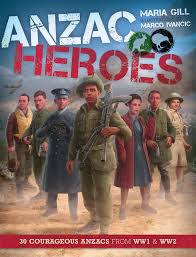
This is a quote from page 68 of Maria Gill’s “Anzac Heroes”, and it gives you an idea how exciting this book is to read. ‘Reg’ is Reginald Saunders and there is a really realistic picture of him in uniform holding a massive machine gun over his shoulder, the same image is on the cover. We can scan the page and very easily tell exactly what medals he was awarded for his bravery. The coloured medal icons are listed in the helpful “medals” section at the back of the book. We can also tell very easily which of the five aspects of History Reginald took part in: the little tank icon means ‘Army’. (The other four aspects are Air Force, Intelligence, Medic and Navy). A helpful kangaroo icon tells us that he is Australian. Sometimes when reading ‘Anzac Heroes’ it’s a bit confusing which hero belongs to which war, WW1 or WW2. After all, the Germans were the Baddies in both wars. I figured out though that Reginald belongs to WW2, as page 68 belongs to the second half of the book. There’s a really cool map with lots of arrows on it half way through the book to show that we are moving from WW1 to WW2. There’s a boring timeline too with lots of dates and facts about which battle was which, but I preferred to skip this part and just focus on the really cool war stories.

Some really racist and sexist books about war focus just on heroic white men. Anzac Heroes doesn’t do this, it has several brown heroes (both Aboriginal and Maori) and several women. The women aren’t quite as cool as the men because they only get to be nurses or spies. The Aboriginal and Maori soldiers are really cool though, they were really brave and sometimes scared the Germans by doing Hakas and war dances. Actually, even though there were lots of racist people back in the old days, war was really good for Maori and Aboriginal soldiers. Soldiers like Reginald Saunders got lots of awards and like it says on page 69 the RSL even set up a scholarship in his name for Aboriginal people. Another example is the Maori soldier Lt Col Sir Peter Buck who proved how awesome he was in Gallipoli and then got to be second in command of the Maori Battallion and then became a famous anthropologist.

The best things I liked about ‘Anzac Heroes’ were the pictures and the really realistic war stories and how heroic the soldiers were. You get to learn all about different types of medals and lots of different battles. There are also some very helpful and in-depth sections at the back which talk about things like The Military, The Medics and a Glossary. So you can look up funny words like ‘gangrenous’, ‘panzer’ and ‘flak’. There’s even a section which explains in depth why the Anzac heroes had to fight against the Germans:

At the beginning of the 20th Century, New Zealand and Australia were part of the British Empire as self-governing Dominions. When Britain went to war, they committed themselves to defending Empire. Politicians worried that the war would spread to their shores and wanted to support the Empire’s effort to prevent that from happening.

So I think that the moral or the message of the book is that Anzac Heroes needed to fight the Germans so that they didn’t land in Australia or New Zealand and take over our countries. If it wasn’t for the brave and daring fights that they got into, we’d all probably be speaking German now and doing Nazi salutes.

But really the best thing about Anzac Heroes that stood out for me and would make me recommend it to my friends and family was the fact that it wasn’t even about politics or history it was about character and bravery. Like it says in the introduction:

“While reading about each hero you will discover what built their character, what helped and hindered them during the war, and what happened to them afterwards – if they made it home.”

So in conclusion I think Anzac Heroes is a really good book which belongs on the bookshelf of every New Zealand and Australian home. It’s got lots and lots of important facts about heaps of battles from WW1 and WW2 and also some really realistic pictures. It has a personal touch which means it isn’t boring to read and also it is very moving and emotional because of the sacrifices made by the Anzac soldiers. Lest We Forget.


Saturday, 1 August 2015

Links Update - war profiteering, a potential peace initiative, Archibald Baxter Memorial Trust

A few months ago I received an email from Stuart Moriarty - Patten, with a link to his article about War profiteering in the Gisborne Herald. I should have put up a link then, but never actually did. I noticed that the same article got reprinted in the 'No Glory' website here:

http://noglory.org/index.php/articles/478-war-is-a-racket-how-new-zealand-was-hurt-by-ww1-profiteers-too 

World Military Expenditure


I’ve been studying the SIPRI military expenditure database quite closely, trying to get my head around the statistics to do with world totals. The first challenge is the sheer size of the data: billions and trillions of $US. According to the latest SIPRI factsheet (April, 2015), world military expenditure in 2014 was $1776 billion. If you look at the raw spreadsheet data, you get a more exact figure of


$1776.15478538343 (billion)


That’s this number: $1776154785383.43

Sunday, 19 July 2015

New Zealand’s Military Expenditure


A few weeks ago Bryce Edwards wrote an interesting column called ‘New Zealand’s Military future[i]’. He provided links to numerous recent articles which discussed the current government’s Defence Review, and the question of how much New Zealand should spend on its military. The most prominent commentators Edwards linked to were Chris Trotter and Karl du Fresne, both of whom argued that New Zealand should seriously consider increasing its spending on “defence”.


I’m going to declare my cards very clearly before going any further: I think that increasing New Zealand’s “defence” spending is both wrong and absurd, and I agree with commentators like Bob Jones and Richard Jackson that New Zealand’s “defence” budget should be zero dollars. I think that a much better and more historically appropriate term for “defence spending” would be “offence spending”. But for the purposes of this blog article I am going to strive to put my ideological position to one side. I will use the neutral term “military spending”, and I will refrain from making any comments about imperialism, nationalism, how nasty and dangerous China might be in the future, and so on.


Instead, I will focus very narrowly on some claims both du Fresne and Trotter make about the size of New Zealand’s military spending and how it compares to other countries. Both commentators blithely and confidently claim that New Zealand doesn’t spend very much at all on its military, especially in comparison to its major allies: the US, UK and Australia. Trotter says:

Saturday, 11 April 2015

John Key's Gallipoli Wisdom


I've been working on a sort of 'side project' recently which involves learning more about the Middle East. I'm particularly interested in the historical connections between what we see happening now in places such as Syria and Iraq, and the dissolution and carving up of the Ottoman Empire after WW1. I'm also interested in Turkey, one of the most powerful and relatively stable states to form out of the ruins of the Ottoman Empire. As I wrote a couple of years ago, it was the experience of travelling in Turkey and seeing all of the massive monuments dedicated to Kemal Ataturk which got me thinking about the strange and disturbing reality of the New Zealand Anzac tradition.


Tuesday, 7 April 2015

Should we commemorate a 'colour blind' Anzac day?


Which wars are more significant for New Zealand's history, the wars of dispossession waged against Maori during the 19th century or the imperialist wars of the 20th century? Anzac day effectively captures the century between 1915 and 2015, but reduces the previous era of settler colonialism to an insignificant status. Australia has a similar pattern, and struggles with the issue of recognising its 'indigenous diggers'.


Rachel Buchanan's article 'The dementia wing of history' is a really insightful critique of the “Tomb of the Unknown Warrior”. Here is a sample:


The absence of any reference to New Zealand's first wars at the Tomb of the Unknown Warrior or at the National War Memorial that looms up behind it, suggests that these wars are moving even further from the centre of national collective memory. The wars of foundation are certainly not forgotten but they remain peripheral, problematic and contested, unable, somehow, to be integrated into popular, bicultural rituals of commemoration.


Monday, 6 April 2015

Some thoughts on the 'Camp Gallipoli' saga


I knew nothing about the 'Camp Gallipoli' concept until today when I heard about it on the radio. For the price of a mere $100, New Zealanders would be entitled to the privilege of camping out under the stars in Ellerslie Racecourse, honouring the memory of the brave Anzacs by sleeping outside and being woken at dawn for a special memorial service. Local band Evermore would provide the theme tune to the event, and high profile New Zealanders such as Sir Richard Hadlee, Sir Graham Henry, Annabel Langbein and Nigel Latta were backing the event alongside the RSA.


Unfortunately for the organisers only 102 people bought tickets, and they have had to cancel the event because it is not viable. It was planned to attract between 10,000 and 20,000 people.


Friday, 27 February 2015

Anzac rhetoric and the Iraq war

I recently posted a comment on facebook expressing my outrage and disgust at Hekia Parata's comments in support of the move to send NZ troops to Iraq. Like many other people in New Zealand I'm angry at the Key government for maneuvering us into this misguided war. My emotional response was further inflamed by these words quoted in a recent (26/02) Herald article :


Education Minister Hekia Parata said in a fiery speech she was raised on the history of war heroes and turning out for Anzac Day and the point of having a defence force was to carry out such deployments. She said the country could not evoke the emotion of turning up to Anzac Days but then turn away when the practical reality of what that meant presented itself.


The article continues with sickening details from Parata's speech. She links Anzac “values” with the content of the New Zealand school curriculum, and argues that we should send troops to be true to that legacy of courage, responsibility and wisdom.


Saturday, 18 October 2014

The Anzac – Silver Fern – Security Council Trifecta: Prospects for NZ nationalism in 2015

Our Anzac day has always been a fairly muted and low key version. Compared to Australian version it is nowhere near such a big deal here. But at the same time it has definitely gone under a resurgence of popularity recently. With the centenary in 2015, it will be a big deal – lots of media attention etc etc. At the same time later in the year there will be a flag change referendum. And at the same time NZ has spent millions, and won a place on the UN security council. The spin is we are able to contribute a “unique and independent voice” to the council.


Friday, 16 May 2014

Missions and Objectives

I have just been reading through the “Missions and Objectives” of the official government project for WW1 centenary commemorations. You can see for yourself at this website


I was compelled to make some comments of my own.