Showing posts with label Reviews. Show all posts

Wednesday, 10 August 2016

Heroic Hogwash


German planes bombed Reg’s ship and he made a lucky escape from the wrecked boat. When he arrived in Crete, he had only the clothes he wore and nothing else. After thousands of enemy paratroopers parachuted into Crete, Reg’s battalion was meant to replace 20th Battalion, which had counterattacked Maleme airfield, but arrived too late to succeed. They withdrew to the new frontline at Souda Bay, nicknamed 42nd Street. When a raiding party of 400 Germans stumbled into sight, the Anzacs called out a battle cry, firing as they ran, thrusting their bayonets at the enemy. The German fighters fled for their lives.

“They were highly trained Germans, but they got such a shock at our din and the way we ran that they forgot they were supermen, and ran … the whole 400 of them.”

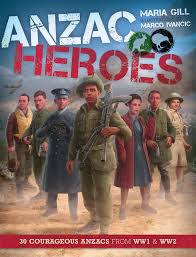
This is a quote from page 68 of Maria Gill’s “Anzac Heroes”, and it gives you an idea how exciting this book is to read. ‘Reg’ is Reginald Saunders and there is a really realistic picture of him in uniform holding a massive machine gun over his shoulder, the same image is on the cover. We can scan the page and very easily tell exactly what medals he was awarded for his bravery. The coloured medal icons are listed in the helpful “medals” section at the back of the book. We can also tell very easily which of the five aspects of History Reginald took part in: the little tank icon means ‘Army’. (The other four aspects are Air Force, Intelligence, Medic and Navy). A helpful kangaroo icon tells us that he is Australian. Sometimes when reading ‘Anzac Heroes’ it’s a bit confusing which hero belongs to which war, WW1 or WW2. After all, the Germans were the Baddies in both wars. I figured out though that Reginald belongs to WW2, as page 68 belongs to the second half of the book. There’s a really cool map with lots of arrows on it half way through the book to show that we are moving from WW1 to WW2. There’s a boring timeline too with lots of dates and facts about which battle was which, but I preferred to skip this part and just focus on the really cool war stories.

Some really racist and sexist books about war focus just on heroic white men. Anzac Heroes doesn’t do this, it has several brown heroes (both Aboriginal and Maori) and several women. The women aren’t quite as cool as the men because they only get to be nurses or spies. The Aboriginal and Maori soldiers are really cool though, they were really brave and sometimes scared the Germans by doing Hakas and war dances. Actually, even though there were lots of racist people back in the old days, war was really good for Maori and Aboriginal soldiers. Soldiers like Reginald Saunders got lots of awards and like it says on page 69 the RSL even set up a scholarship in his name for Aboriginal people. Another example is the Maori soldier Lt Col Sir Peter Buck who proved how awesome he was in Gallipoli and then got to be second in command of the Maori Battallion and then became a famous anthropologist.

The best things I liked about ‘Anzac Heroes’ were the pictures and the really realistic war stories and how heroic the soldiers were. You get to learn all about different types of medals and lots of different battles. There are also some very helpful and in-depth sections at the back which talk about things like The Military, The Medics and a Glossary. So you can look up funny words like ‘gangrenous’, ‘panzer’ and ‘flak’. There’s even a section which explains in depth why the Anzac heroes had to fight against the Germans:

At the beginning of the 20th Century, New Zealand and Australia were part of the British Empire as self-governing Dominions. When Britain went to war, they committed themselves to defending Empire. Politicians worried that the war would spread to their shores and wanted to support the Empire’s effort to prevent that from happening.

So I think that the moral or the message of the book is that Anzac Heroes needed to fight the Germans so that they didn’t land in Australia or New Zealand and take over our countries. If it wasn’t for the brave and daring fights that they got into, we’d all probably be speaking German now and doing Nazi salutes.

But really the best thing about Anzac Heroes that stood out for me and would make me recommend it to my friends and family was the fact that it wasn’t even about politics or history it was about character and bravery. Like it says in the introduction:

“While reading about each hero you will discover what built their character, what helped and hindered them during the war, and what happened to them afterwards – if they made it home.”

So in conclusion I think Anzac Heroes is a really good book which belongs on the bookshelf of every New Zealand and Australian home. It’s got lots and lots of important facts about heaps of battles from WW1 and WW2 and also some really realistic pictures. It has a personal touch which means it isn’t boring to read and also it is very moving and emotional because of the sacrifices made by the Anzac soldiers. Lest We Forget.


Tuesday, 26 April 2016

Best of Anzac day 2016

I have been meaning to write here for some time, but for various reasons it just hasn't happened. Top of my list is to write about the year 1916 - the year of the first Anzac day commemoration, and also the year conscription was introduced. It's a dark and shameful year in New Zealand's history, in which the rhetoric of sacrifice is the driving force behind the move to introduce compulsory military service. Was the first Anzac day commemoration a significant part of this lead up to the introduction of conscription? How did people opposed to New Zealand's involvement in the imperialist slaughter deal with the emotionally charged atmosphere of the time? Hopefully I will have the time soon to do justice to these questions.

In lieu of anything original, here are my Anzac picks of 2016:

The best and most prominent act of counter propaganda was without doubt the fantastic Archibald Baxter - field punishment - "guerilla installations" dotted around Wellington. What makes this even better is the Stuff article and the accompanying video, unusually positive for this time of year: http://www.stuff.co.nz/national/last-post-first-light/79299545/conscientious-objector-archie-baxter-remembered-in-guerilla-wellington-sculpture

Peace Action Wellington may or not be responsible for this, but they have some really good pictures of the Archie mannequins: https://peaceactionwellington.wordpress.com/

Renee Gerlich takes on the grotesque spectacle of Peter Jackson's 'Scale of our War' exhibition at Te Papa, and does a fine job of cutting it down to size. I was somewhat depressed when I visited Wellington recently and saw for myself the massive ques of people lining up to see this exhibition. If only they could all be directed to this:

Not only does Te Papa seek to re-sell the “grand adventure” story all over again, but to bond us to it, have us identify with it. Through the uniforms you can don, the questions you are invited to answer, the poppies you can leave heartfelt messages on – but also through its insistence on speaking in the first person plural. It’s the scale of “our” war. “We” were in Egypt when they told “us” that “we’d” be invading Gallipoli. “The Turks had sided with the Germans in the war, and we were itching to take them on… that’s where the action was.” That text is not even quoted from a letter or a journal. That’s just Te Papa speaking – as your quintessentially Kiwi, male war hero “mate”.

Read the full blog here: https://reneejg.net/2016/04/22/gallipoli-the-scale-of-our-war-propaganda/

Over the ditch where the Anzackery is even more hyped and pumped by gazillions of state dollars, not everyone is buying the same old story. Historian and aboriginal activist Gary Foley contrasts the attention paid to Anzac day with the denial of Australia's own colonial history: http://www.theage.com.au/comment/gallipoli-not-the-only-war-to-define-australian-warfare-20140424-zqymi.html

I posted last year about Scott McIntyre, the sports reporter who was fired from his job after a series of 'offensive' tweets about Anzac day. McIntyre referred to several historical episodes which are typically ignored by Anzac commentators: the so called 'battle of the Wazza', the Surafend massacre, the raping of Japanese women by Anzac soldiers and our complicity with the mass murder of Hiroshima and Nagasaki in 1945. It is not hard to imagine the immense pressure someone in McIntyre's position must have come under after this episode, so I am very impressed to see that he has not succumbed and continues to offend people blinded by Anzac nonsense: http://www.theguardian.com/news/2016/apr/25/former-sbs-reporter-scott-mcintyre-repeats-anzac-day-accusations-on-twitter

Finally, this youtube video of a debate between Australian academics is really worth a look. I think it might be from a year or two ago, but I only discovered it today thanks to the sharing miracles of facebook. The moot is the proposition "Anzac day is more puff than substance", and the first speaker (Jeff Sparrow) absolutely nails it. He starts about seven minutes into the clip, and doesn't talk too long: https://www.youtube.com/watch?v=pk5MgWXDM2A&feature=youtu.be&t=7m16s


Wednesday, 1 April 2015

The Deceptions of Remembrance: how does the Anzac myth frame WW1 history?

(This is an edited version of an earlier post, which was much longer and politer. As April 25th approaches I am inclined to increase the anger and outrage on this blog. Lest We Remember.)


There are two massive photographic images which border the entrance to the 'Dunedin's Great War' exhibit currently on display at the Otago Early Settler's Museum. One one side a small boy is saluting a large Union Jack flag. On the other side is the picture of a young Otago Anzac soldier dressed in a kilt. As you walk in to the exhibit you are surrounded by brightly lit photos of the faces of the young men from Otago who died during the first world war, large panels of bright red poppies and gravestones. These images are deceptively innocent, powerfully framing the way in which we are supposed to 'remember' our history of involvement with the imperialist bloodbath which took place during the years between 1914 and 1918.


Monday, 2 February 2015

The Curator's Reply


The short history of this blog has so far been a fairly lonely one. I have received a few positive comments from like minded friends and people who share my perspective on New Zealand's role in WW1. While these are appreciated, I had hoped to receive some critical comments too. Many of the opinions expressed in this blog are clearly opposed to the more mainstream views of Anzac day seen in Newspapers, TV and various magazines. I provided a link to my blog at the official government “WW100” site, and various other internet sites which related to this topic. The results were a handful of views, but no comments on any of my posts.


Tuesday, 6 January 2015

Letter to the Otago Early Settler's Museum

I'm a regular visitor to the Otago Settler's Museum, it's a great place for my 2 year old boy to run around in and occasionally look at the exhibits. The 'Dunedin's Great War' exhibit has been going for several months now, and over time I have managed to look at a few snippets of it when I am not busy looking after my boy. The title of the exhibit, and the central image of the small child saluting the union jack, I find highly objectionable. The emphasis on remembrance of the dead and military history, and the marginalisation of almost all other aspects of the war is not really very surprising. These more or less obvious ideological points aside, I was motivated to write a letter to the curator because of some factual innaccuracies and omissions. I think I have succeeded in being polite and reasonable sounding, while at the same time not pulling any punches:

Thursday, 4 December 2014

In the shadow of Gallipoli - review

In the Shadow of Gallipoli: The hidden history of Australia in World War I

By Robert Bollard

Pub. NewSouth 2013


I spotted this book in the display section in Dunedin Public library a few months ago. There's a mountain of literature on Gallipoli, and a fairly large chunk of it seems to revolve around questions of military strategy and personal details about the soldiers who died. I knew nothing about Robert Bollard, so I was pleasantly surprised when I found out that he was a Marxist historian, and that the book wasn't really about Gallipoli at all. Instead, this book tells the fascinating story of the labour struggles in Australia between the outbreak of WWI in 1914 and the early 1920s.


Saturday, 27 September 2014

Embarkation Carnival, September 2014

Keeping up with history is hard work. I find myself going through ebbs and flows with this WW1 project of mine – especially since the birth of my second son, I realise that there are many other things I care about a lot more than Anzac day. Having said that, now that we have officially passed the 'starting line' of the centenary, it actually looks like we could be in for an Anzac day which starts in late September and ends – well, maybe it will never end, but we might have to wait until sometime around 2018.

Friday, 13 June 2014

WW1 vs. WW2 in 1957


I've been thinking quite a lot about the claim I made in an earlier post that world war one is 'overshadowed' by world war two. Since writing that post, I've watched two films which I think illustrate that claim in an interesting way: The Bridge on the River Kwai, David Lean's famous movie about WW2 prisoners forced to build a bridge for the Japanese, and Paths of Glory, Stanley Kubrick's not so famous movie about French soldiers in WW1.

Wednesday, 14 May 2014

Inglorious Basterds, a Donkey Bridge and an Ex Nazi

The First World War is fairly consistently overshadowed by its more spectacular and far more deadly sequel, World War Two. Although many historians and intellectuals might regard both wars as being equally momentous and consequential, I think that from the perspective of popular culture in the 21st century, WW2 wins against WW1 in terms of fame and impact by a large margin. I'm not sure what the exact statistics are, but I am quite certain that the number of Hollywood movies made about WW2 far exceeds the number made about WW1. There are some very interesting and notable movies made about WW1, such as All Quiet on the Western Front. Whatever artistic merits these films might possess, they lack a crucial ingredient: the Nazis.


Wednesday, 23 April 2014

Another puff of air

It's somewhat disappointing that the Guardian published this article
  
But I managed to get in the first BTL comment .... nice to see some conscious Aussies there saying sensible things too.

Tuesday, 22 April 2014

Field Punishment No. 1

Here's a link to a preview of the movie in case you missed it. 


I should be grateful, I suppose, that a movie based on Archibald Baxter's memoir We Will Not Cease has been made at all. I should be even more proud of TV One for showing the movie last night in prime time. Baxter and the other conscientious objectors are portrayed as proud – and more importantly brave – men of high moral principle. The officers were nasty. The trenches were awful. The nurse at the hospital was pretty. It was a sad and terrible war and this was duly emphasised by the incessant and emotive piano soundtrack.